
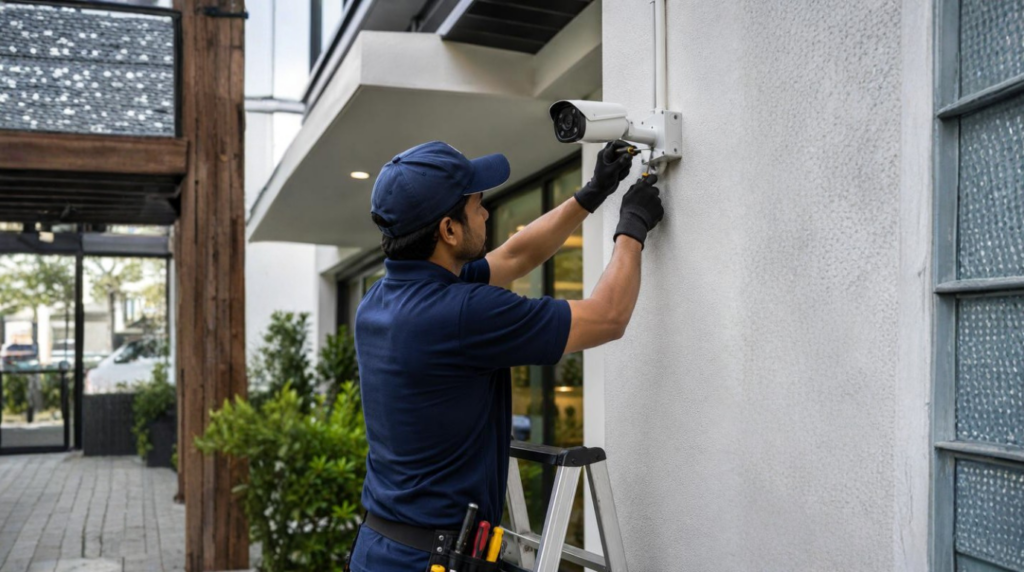
CCTV Camera Installation in Delhi: Your Complete Guide to Home & Business Security
CCTV camera installation in Delhi costs between ₹8,000 to ₹35,000 depending on the number of cameras and property size. Third Eye Security provides professional CCTV installation across Delhi NCR with 25+ years of experience, serving homes, offices, and commercial properties. This guide covers everything you need to know about CCTV installation in Delhi.
Most people think about security only after something goes wrong — a theft from the office storeroom, an incident in the parking basement, or a shoplifting episode that the grainy footage couldn’t resolve. Across Delhi, from a South Extension pharmacy to a Shahdara garment warehouse, the pattern repeats itself: the camera was there, but the system wasn’t planned properly.
A professional CCTV camera installation in Delhi does more than put hardware on a wall. When done right, it deters incidents before they happen, creates accountability in operations, and gives you verifiable footage when you need it most — from anywhere, on any device.
This guide covers what a truly complete security solution looks like, how to match the right setup to your specific property, and what professional installation actually involves.
Why Delhi Properties Can’t Afford to Under-Invest in Security Right Now
Delhi runs at a pace that makes security gaps expensive — fast. An unmonitored retail counter, an uncovered server room, a warehouse gate without a camera: each is a vulnerability waiting to cost you.
India’s CCTV market is projected to grow from USD 5.75 billion in 2026 to USD 14.25 billion by 2031 at nearly 20% annually. North India is at the core of that expansion. North India led the country with a 42.25% revenue share of the CCTV market in 2025, driven in part by Delhi’s 700,000-camera network — a figure that spans government deployments, commercial buildings, and residential properties across the NCR. According to Mordor Intelligence’s India CCTV market report, this momentum is being further accelerated by Smart Cities Mission rollouts and compliance mandates.
What this means practically: IP camera hardware has become significantly more affordable. HD systems that once required enterprise budgets now fit within reach of a small shop owner in Karol Bagh or a homeowner in Rohini. The barrier has shifted from cost to getting the system designed and installed correctly.
A Complete Security System: More Than Just Cameras
This is where most first-time buyers go wrong. They install cameras. The footage quality looks fine. Then an incident happens — and the recordings are missing because storage was never configured, or the angle covered the wrong zone entirely.
A genuinely complete security system installation in Delhi is built in layers, each solving a different problem:
CCTV Cameras are the visible deterrent and primary evidence tool. Camera type, mounting angle, resolution, and night-vision capability all determine whether your footage is useful in an investigation or just noise.
DVR & NVR Recording Systems are what make the cameras worth having. A properly configured DVR & NVR recording system handles video storage, remote playback, motion-triggered alerts, and scheduled recording. Without it, 16 cameras produce nothing retrievable.
Access Control Systems track who enters sensitive areas and when. Access control in Delhi typically integrates biometric readers, proximity cards, and electromagnetic locks — particularly valuable for offices, data centres, and pharmaceutical storage rooms.
Video Door Phone Systems let staff visually verify visitors before granting entry. A video door phone is especially useful for clinics, builder floors, and small offices — reducing social-engineering risks as much as physical ones.
Intruder Alarm Systems activate perimeter sensors at doors and windows if forced entry is detected. Intruder alarm systems work best alongside CCTV: the camera confirms the alert; the siren deters the intruder.
Each layer targets a different failure point. A camera records what happened; access control determines who could reach the area in the first place.
CCTV Camera Types: Matching the Camera to the Location
Camera technology has diversified enough that a single model no longer works across all situations. Here’s how to think through the options before buying:
Dome Cameras are ceiling-mounted and compact — the standard choice for building lobbies, office interiors, retail floors, and hotel corridors. Their design makes it difficult for outsiders to see exactly where the lens is pointed, adding a psychological deterrent effect.
Bullet Cameras are directional and long-range — better suited for outdoor perimeters, parking areas, and entry gates. They’re more visible, which itself deters tampering in open spaces.
PTZ (Pan-Tilt-Zoom) Cameras are operator-controllable and ideal for factory floors, large warehouses, or open parking lots where a single camera needs to cover a wide area dynamically.
IP Cameras transmit digital video over ethernet or Wi-Fi and support remote monitoring through mobile apps. For business owners managing multiple Delhi locations or frequently travelling, IP systems eliminate the need to be physically on-site to review footage.
Wireless Cameras work well for older buildings where running cable through existing walls isn’t practical — though stable network connectivity is non-negotiable for reliable performance.
Not sure which type suits your property? A site survey before purchase is always the right sequence. See the full breakdown on Third Eye Security’s CCTV camera installation page.
Home Security vs. Business Security: Why the Setup Is Different
A 2BHK apartment in Dwarka and a textile showroom in Chandni Chowk have fundamentally different security needs — and a one-size installation serves neither well.
For residential properties, the typical requirement is 4–8 cameras covering the main entrance, living room, balcony, parking space, and staircase or hallway. The priorities are remote mobile access, motion alerts, and relatively simple operation. Wireless and IP cameras are popular here given the ease of cable-free installation. For homeowners comparing options, this guide to the best CCTV cameras for home in India 2026 covers top-rated models across budget brackets.
For commercial and industrial properties, the design logic changes: higher camera counts, longer storage retention (30–90 days vs. 7–15 for most homes), lower-light performance, and integration with access control and time-attendance systems. A factory floor needs cameras rated for dust and humidity; a hospital needs discreet placement that covers pharmacy stores and cash counters without compromising patient-area privacy.
Brand selection matters here too. Third Eye Security works with CP Plus, Hikvision, Bosch, Honeywell, and Panasonic — each suited to different budget levels and feature requirements. If you’re weighing the two most popular Indian market options, this breakdown of CP Plus vs. Hikvision in 2026 covers practical differences across image quality, pricing, and service network.
Industries We Serve Across Delhi NCR
Security risks are sector-specific — what a garment exporter in Okhla needs is very different from what a school in Vasant Kunj requires. Third Eye Security’s industry security solutions for Delhi are structured around these differences:
- Offices & corporate campuses — access control + CCTV for server rooms, entry lobbies, and car parking
- Retail & showrooms — loss prevention through POS-area cameras and wide-angle floor coverage
- Hospitals & clinics — pharmacy stores, emergency corridors, and patient entry areas
- Factories & warehouses — PTZ and bullet cameras for perimeter and production floor monitoring with long-retention NVR setup
- Educational institutions — gate cameras, corridors, and parking zones for student safety compliance
- Residential societies & builder floors — common area surveillance, boom barriers, and video door phone integration
What Professional CCTV Camera Installation in Delhi Actually Involves
The difference between a system that works reliably for years and one that needs constant troubleshooting usually comes down to installation quality — not the brand on the camera box.
A structured professional installation follows this sequence:
- Site Survey — A technician visits to assess existing coverage gaps, map blind spots, and plan camera positions before any purchase is finalized.
- Custom System Design — Camera count, types, cabling routes, recorder placement, and storage capacity are specified for your exact property.
- Professional Cabling & Mounting — Clean cable management, correct mounting heights, and weatherproofing for all outdoor cameras.
- DVR/NVR Configuration — Recording schedules, motion alert thresholds, remote access setup, and storage retention are all configured to spec.
- Testing & Handover — All camera angles are verified live, mobile app access is set up, and the property owner receives a full system walkthrough.
- AMC (Annual Maintenance Contract) — Scheduled health checks and priority fault response keep the system operating at full capacity year-round.
With 25+ years of experience installing and maintaining surveillance systems across Delhi NCR — from 3-camera home setups in Pitampura to 60-camera commercial installations in Narela Industrial Area — Third Eye Security brings this structured approach to every project size.
Frequently Asked Questions
How many cameras does a typical home in Delhi need?
Most 2BHK to 4BHK homes require between 4 and 8 cameras for complete coverage of the entrance, living room, balcony, parking, and key blind spots. A compact flat may need just 3; a large villa or independent floor may need 10 or more. The only reliable way to determine the right count is a brief site survey.
Can I monitor my Delhi CCTV footage from another city or abroad?
Yes. Modern IP cameras and internet-connected DVR/NVR systems support remote viewing through mobile apps. As long as the recorder is online, you can access live feeds, review recorded footage, and receive motion-based alerts on your phone from anywhere in the world.
How long does CCTV footage stay stored?
Residential systems typically retain 7–15 days of continuous footage. Commercial properties — particularly banks, hospitals, and logistics facilities — often require 30–90 days. Retention duration depends on camera count, recording resolution, and hard drive capacity installed in the DVR/NVR.
Which CCTV brand is better for Delhi homes — CP Plus or Hikvision?
Both are reliable and widely serviced in India. CP Plus offers strong value at mid-range budgets with an extensive service network across Delhi. Hikvision provides superior image processing and AI-based analytics at a slightly higher price point. The right choice depends on your budget, required features, and the importance of long-term local service availability.
Do you provide AMC services after CCTV installation?
Yes. Third Eye Security offers Annual Maintenance Contracts covering scheduled servicing, firmware updates, and priority response for hardware faults — ensuring your surveillance system remains reliable beyond the installation date.
Get Your Delhi Property Properly Secured
A CCTV camera is only as effective as the system it’s part of. Placement, storage configuration, access control integration, and maintenance are what convert hardware into dependable security. Whether you’re looking at a home setup in Janakpuri or a multi-site commercial deployment across Delhi NCR, the right starting point is a professional site survey — not a catalogue purchase.
Contact Third Eye Security to schedule a free site survey and receive a no-obligation quote for your home or business property.

Third Eye Security and Surveillance Systems is a Delhi-based electronic security company with 25+ years of experience. We specialise in CCTV camera installation, fire alarm systems, access control, and integrated security solutions for homes, offices, and commercial properties across Delhi NCR. Our team of certified security experts has served 500+ clients and continues to deliver reliable, customised security infrastructure.