
Fire Alarm System for Shops & Offices in Delhi: Types, Cost & What the Law Requires
Fire alarm system installation in Delhi costs between ₹60,000 to ₹4,00,000 depending on system type and property size. Third Eye
Security installs conventional and addressable fire alarm systems for shops, offices, and commercial properties across Delhi NCR — fully compliant with NBC 2016 and Delhi Fire Prevention Act requirements.
A fire incident in a commercial property rarely announces itself. It can start from a short circuit in the server room, an overloaded power strip behind a storage rack, or a kitchen exhaust in a restaurant that hasn’t been serviced in months. In Delhi’s densely packed commercial areas — Karol Bagh, Lajpat Nagar, Okhla Industrial Area, Connaught Place — the speed of early detection is often the difference between a contained incident and a catastrophic loss.
This guide covers what you actually need to know as a shop owner or office manager in Delhi: the types of fire alarm systems available, what a realistic installation costs, and the legal requirements you cannot ignore.
Why Every Delhi Shop and Office Needs a Fire Alarm System
Most fire-related property damage and casualties happen because there was no early warning. A functional fire alarm system gives occupants the time to evacuate and gives the fire department the head start it needs to contain damage. That is its core job.
But there is a second, equally practical reason: legal compliance.Fire safety norms in India are mandated through the National Building Code 2016, State Fire Services Acts, and sector-specific regulations… — applicable to commercial buildings, hospitals, hotels, educational institutions, and office spaces. For Delhi businesses, this means a fire alarm system is not a discretionary upgrade — in most cases, it is a regulatory requirement tied directly to your operating license and trade certificate.
The consequence of ignoring this is serious. Non-compliance can result in fines ranging from ₹10,000 to ₹10,00,000 or more, depending on the state, and municipal corporations can seal buildings for persistent violations.
Types of Fire Alarm Systems: Conventional, Addressable & Wireless
The three main types of fire alarm systems have meaningfully different capabilities, price points, and ideal use cases. Choosing the wrong one for your premises leads to either overspend or an underpowered system.
Conventional Fire Alarm Systems
Conventional systems group detectors into zones. When any device in a zone triggers, the control panel indicates an alarm for that entire zone — but not the exact device or location. Think of it as a neighbourhood-level alert: it tells you a floor has a problem, not which room.
These are best suited for small, single-floor shops, small standalone offices, or compact commercial spaces where quick manual investigation is easy. They are also the most budget-friendly entry point.
Typical use case: A 500–1,000 sq ft retail shop or a small 3–4 room office in Delhi.
Addressable Fire Alarm Systems
Addressable systems assign a unique ID to every individual device — each detector, manual call point, and sounder. When an alarm triggers, the control panel identifies the exact device and its location. In a multi-floor office building or a complex retail environment, this precision saves critical response time.
Addressable systems are also more resistant to false alarms, since the panel can distinguish between genuine fire signatures and nuisance triggers like cooking steam or construction dust. For commercial properties above a few thousand square feet, or any multi-story building, an addressable system is the right long-term choice.
Typical use case: A 5,000–20,000 sq ft office block, a hotel, a hospital wing, or a factory floor in Delhi NCR.
Wireless Fire Alarm Systems
Wireless systems use radio frequency communication instead of physical cabling between devices. They cost more per device but significantly reduce installation labour — particularly useful for older buildings in Delhi where chasing cables through finished walls would be destructive or impractical.
Typical use case: Heritage commercial properties, buildings with finished interiors, or short-term lease premises where cabling is not feasible.
Third Eye Security offers both conventional and addressable fire alarm systems through trusted brands — MORLEY (Honeywell), NOTIFIER, and RAVEL. See the full fire alarm detection system page for the complete service overview.
Key Components Every Fire Alarm System Must Have
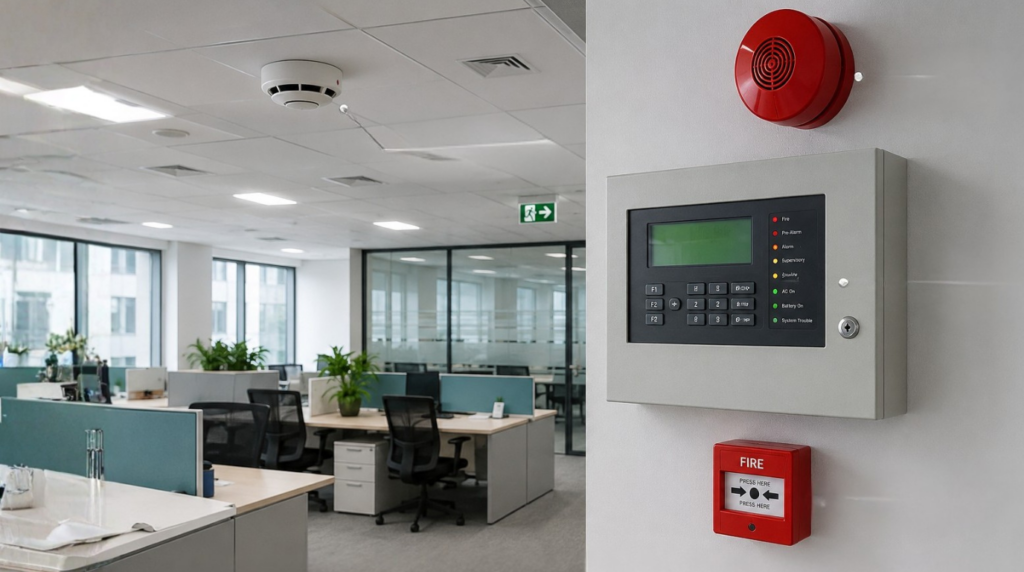
Regardless of which system type you choose, a fully functional fire alarm installation requires these core components:
Smoke Detectors detect airborne smoke particles from smoldering or flaming fires. Optical (photoelectric) detectors are the most common type and perform well across most commercial environments. They are mounted on ceilings at specified spacings based on area coverage calculations.
Heat Detectors are the right choice for areas where smoke detectors would cause nuisance alarms — kitchens, parking basements, server rooms with cooling systems, and industrial zones with dust or steam. They trigger at a set temperature threshold or at a rapid rate of temperature rise.
Manual Call Points (MCPs) — also called break-glass units — allow any occupant who spots a fire to manually trigger the alarm without waiting for a detector to activate. These are mandatory in most commercial and public buildings and are typically installed near staircase exits and entry/exit points.
Control Panel is the system’s central processor. It monitors all connected devices, receives alarm signals, and activates output devices. Panel type (conventional vs. addressable) determines how much location information you get when an alarm fires.
Hooters & Alarm Devices produce the audible and/or visual alert that warns building occupants. In larger premises, voice evacuation systems provide directional guidance over a PA network.
Cost of Fire Alarm System for Shops & Offices in Delhi: : Realistic Numbers to Budget Against
Fire alarm system pricing in India depends on building size, number of floors, system type, detector count, cabling complexity, and brand. Here is a realistic breakdown based on current India-market figures:
Conventional System Costs (fully installed):
- Small shop or office, 8–15 detectors: approximately ₹60,000 to ₹1,50,000
- Medium commercial space with 15–25 devices: approximately ₹1,50,000 to ₹2,50,000
Addressable System Costs (fully installed):
- Small-to-medium office or retail space, 20–50 addressable devices: approximately ₹1,50,000 to ₹4,00,000
- Larger commercial or multi-storey building, 50–100+ devices: ₹4,00,000 to ₹8,00,000+
Individual Component Reference Prices:
- Smoke detector (conventional): ₹800–₹1,800 per unit
- Heat detector: ₹600–₹1,500 per unit
- Manual call point: ₹700–₹1,500 per unit
- Conventional control panel (2–8 zones): ₹8,000–₹35,000
- Addressable panel (entry-level): ₹40,000–₹1,50,000
Annual Maintenance Contract (AMC): Typically 10–15% of total installed system cost per year. For a ₹1,00,000 system, this works out to ₹10,000–₹15,000 per year — a necessary ongoing cost for legal compliance and system reliability.
These are indicative estimates. Delhi NCR installations can sit at the upper end of these ranges due to higher labour costs and more complex cable routing in commercial interiors. A site survey is the only reliable way to get an accurate quote for your specific premises.
Legal Requirements & Fire NOC: What Delhi Commercial Properties Must Know
India’s National Building Code (NBC)… explicitly mandates the installation of Automatic Fire Detection (AFD) systems… in basements used for parking and services, and in high-rise buildings exceeding 24 metres in height. Educational, institutional, assembly, and residential buildings above four storeys are also covered.
For commercial properties — offices, shops, restaurants, clinics, showrooms — the key legal touchpoints are:
Fire NOC (No Objection Certificate): A Fire NOC is a legal document confirming that a building conforms to fire safety standards set by the state fire department and the NBC. It is mandatory for commercial buildings and covers compliance with fire safety equipment such as fire extinguishers, fire alarms, sprinkler systems, fire exits, and other preventive measures. Without a valid Fire NOC, you cannot obtain an occupancy certificate, and many insurers will not process fire damage claims.
Mandatory System Testing: NBC 2016 Part 4 recommends monthly testing of alarm systems, with quarterly inspection of extinguishers. State fire rules typically mandate annual renewal of the building fire NOC, which forces a periodic audit of systems and documentation.
Non-Compliance Consequences: Failure to comply can result in fire department sealing of premises, trade license cancellation, insurance claim rejection, and in serious cases, criminal liability. Non-compliance can result in severe penalties including fines, license cancellations, business closure, and even imprisonment.
IS 2189 Standard: All fire alarm system components and installations in India must conform to IS 2189 — the Bureau of Indian Standards code of practice for selection, installation, and maintenance of automatic fire detection and alarm systems. Always verify that the equipment and installer you engage works to this standard.
Third Eye Security’s complete security system solutions in Delhi include fire alarm systems designed and installed in line with these regulatory requirements.
Industries in Delhi That Need Fire Alarm Systems Most
Fire risk is not uniform across all property types. Third Eye Security’s industry-specific security solutions for Delhi are tailored to the distinct needs of each sector:
- Offices & IT companies — server room fire risk from electrical faults; addressable systems for precise zone identification
- Retail shops & showrooms — high footfall and flammable inventory; conventional systems work for smaller spaces, addressable for multi-floor showrooms
- Restaurants & food courts — kitchen areas need heat detectors (not smoke); system must integrate with exhaust shutdown
- Factories & warehouses in Okhla, Narela, Bahadurgarh — large open spans need beam detectors; high-retention DVR/NVR integration for post-incident investigation
- Hospitals & clinics — strict NBC compliance for patient areas; silent alert modes for staff in sensitive zones
- Educational institutions — mandatory under NBC for buildings above 4 storeys; robust MCPs and loud hooters across corridors
If you are also reviewing your broader security posture, this guide on CCTV camera installation for homes and businesses in Delhi covers surveillance system planning in the same systematic way.
Frequently Asked Questions
Is a fire alarm system legally mandatory for my small shop in Delhi?
For very small standalone shops under 100 sq ft with minimal fire risk, there is no universal statutory obligation to have an automatic fire alarm system. However, if your shop is in a commercial complex, mall, or multi-story building, the building itself is likely required to have a fire alarm and suppression system under NBC 2016 and the Delhi Fire Prevention & Fire Safety Act. Regardless of legal minimums, any commercial space with significant inventory, electrical load, or footfall carries genuine fire risk — and a basic conventional system is a proportionate investment.
What is the difference between a smoke detector and a heat detector, and which does my office need?
Smoke detectors identify airborne smoke particles and provide early warning of smoldering fires — ideal for open office areas, meeting rooms, corridors, and storage rooms. Heat detectors activate when ambient temperature rises sharply or crosses a threshold — better suited for kitchens, server rooms with cooling equipment, and areas with normal dust or steam. Most offices need both, placed in the appropriate zones.
How long does it take to get a Fire NOC in Delhi?
Processing time typically ranges from 15 to 60 days after complete document submission and a successful fire department inspection. Incomplete applications or non-compliant installations are the most common cause of delays. Engaging a professional installer who understands local Delhi fire department documentation requirements significantly reduces back-and-forth.
Can I use the same vendor for fire alarm and CCTV installation in Delhi?
Yes — and it often makes operational sense to do so. A single vendor who handles both fire alarm and surveillance systems can design a coordinated safety infrastructure: CCTV cameras covering emergency exits, access control that unlocks automatically on fire alarm activation, and a unified AMC for both systems. Third Eye Security provides this integrated service across Delhi NCR.
How often does my fire alarm system need to be serviced?
Monthly visual checks of the control panel are recommended for in-house staff. A full professional inspection and functional test by a certified technician should be conducted at minimum bi-annually (every 6 months), as per IS 2189 guidelines. Annual renewal of your Fire NOC also triggers a formal inspection. An AMC with your installation vendor is the most practical way to ensure these schedules are met without chasing calendar reminders.
Protect Your Business Before the Risk Becomes a Reality
A fire alarm system for your Delhi shop or office is not just a safety box to tick — it is the only system that gives you and your team time to get out safely and gives authorities time to contain damage. Whether you are installing for the first time, upgrading from a basic conventional setup, or ensuring compliance before a Fire NOC renewal, the starting point is always a professional site survey.
Get in touch with Third Eye Security to book a free site survey and receive a no-obligation quote for your shop, office, or commercial property across Delhi NCR.

Third Eye Security and Surveillance Systems is a Delhi-based electronic security company with 25+ years of experience. We specialise in CCTV camera installation, fire alarm systems, access control, and integrated security solutions for homes, offices, and commercial properties across Delhi NCR. Our team of certified security experts has served 500+ clients and continues to deliver reliable, customised security infrastructure.