
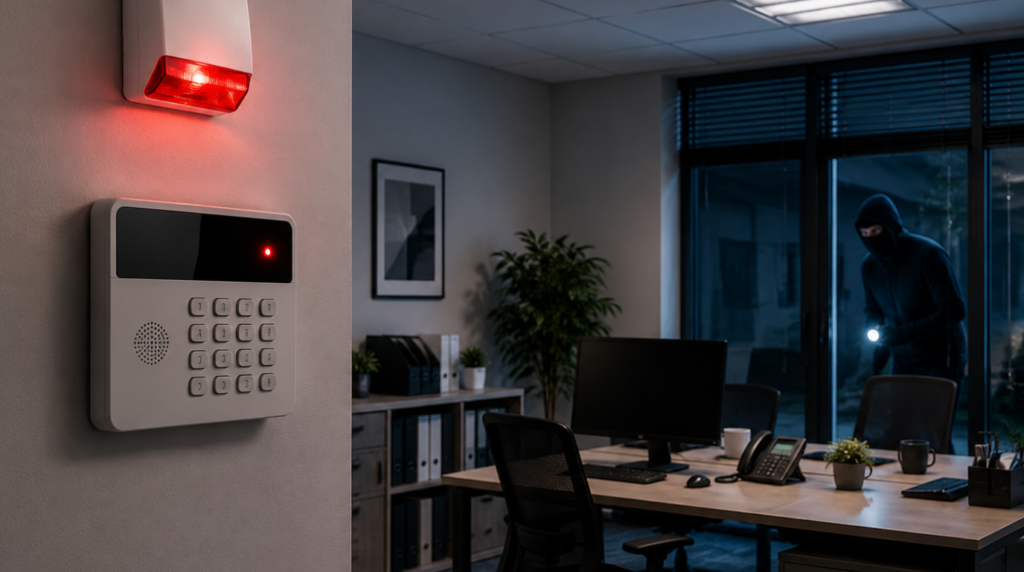
Top 7 Signs Your Office Needs an Intruder Alarm System
An intruder alarm system for a Delhi office typically costs between ₹15,000 to ₹50,000 depending on coverage area and sensor count. Third Eye Security installs wireless and wired intruder alarm systems for offices across Delhi NCR. Here are the top 7 signs your office needs one immediately.
Most office managers only think about intruder alarms after something has already gone wrong — a break-in over a long weekend, a laptop missing from an unlocked cabin, or a late-night entry that nobody noticed until Monday morning. By then, the conversation has shifted from prevention to damage control.
The truth is, most offices give off warning signs long before an actual break-in happens. If you can recognize them early, you can close the gap before it costs you data, inventory, or peace of mind. Here are the seven signs that mean your office security setup isn’t keeping pace with the risk.
Sign 1: Your Office Is Empty for Long Stretches — Nights, Weekends, Holidays
If your office sits unattended from 8 PM to 9 AM on weekdays, and completely empty on weekends and long holidays, you have a 60+ hour window every week where nobody would notice an intrusion in real time.
This is especially relevant in Delhi’s commercial hubs — Nehru Place, Okhla, Netaji Subhash Place — where offices in shared business complexes often go fully dark after standard hours, with security limited to a single ground-floor guard covering an entire building.
An intruder alarm system closes this gap by monitoring entry points continuously, regardless of whether anyone is physically present. Unlike a security guard, it doesn’t get distracted, doesn’t need breaks, and triggers instantly the moment a door or window sensor is breached.
Sign 2: You’ve Had a Break-In or Attempted Break-In Before
If your office has already experienced an actual intrusion — successful or attempted — this is the clearest possible signal. Delhi’s crime data backs up why this matters: Delhi Police recorded around 102,000 theft cases in 2025 alone, alongside over 35,000 vehicle theft cases, even as overall numbers trended downward compared to prior years.
A previous break-in — even a failed one where nothing was taken — usually means your premises has already been scouted or identified as a low-resistance target. Repeat targeting is common because the same structural weaknesses (an unmonitored back entrance, a weak lock, a blind spot) remain unless specifically addressed.
If this describes your situation, don’t just patch the point of entry that was breached. A full intruder alarm system installation in Delhi covers all vulnerable points — doors, windows, and even glass-break scenarios — not just the one that was exploited last time.
Sign 3: Your Office Handles Cash, Sensitive Data, or High-Value Equipment
Not every office carries the same risk profile. If your workspace regularly holds cash reserves, client financial documents, patient records, prototype hardware, or expensive IT equipment like servers and specialized machinery, you are a materially more attractive target than a standard workspace.
This applies broadly across sectors: a chartered accountant’s office holding client financial data, a diagnostic lab storing patient records and expensive equipment, a jewellery design studio, or a tech startup’s server room with proprietary code and hardware.
For businesses in this category, an intruder alarm system paired with access control creates layered protection — the alarm detects unauthorized entry, while access control restricts who can even reach sensitive zones in the first place.
Sign 4: Your Current Security Relies Only on a Guard or a Lock
A security guard and a good lock are useful, but they share the same fundamental weakness — both depend on a single point of human or mechanical reliability, with no backup if that point fails.
Guards get tired, take unscheduled breaks, or simply can’t watch every entry point simultaneously in a building with multiple doors, a rear service entrance, and ground-floor windows. Locks can be picked, and older mechanical locks in many Delhi commercial buildings haven’t been upgraded in years.
An intruder alarm system doesn’t replace your guard or your locks — it backs them up. If a guard misses something or a lock is compromised, the alarm still triggers, and depending on your setup, that alert can go directly to your phone, your security agency, or trigger a local siren instantly.
Sign 5: You Have Multiple Entry Points — Including Ones Rarely Used
Most office break-ins don’t happen through the main entrance. They happen through the side door propped open for deliveries, the fire exit that’s rarely checked, the ground-floor window behind a filing cabinet, or a shared building’s terrace access.
If you’ve never mapped out every possible entry point into your office — not just the front door — you likely have an unmonitored gap. Multi-tenant buildings, which are common across Delhi’s commercial areas, add another layer of risk: shared stairwells, common terraces, and basement parking access can all lead into your specific unit if internal doors aren’t separately secured.
A proper site survey before installation identifies every entry point — including the ones you’ve stopped thinking about because they’re rarely used — and ensures each one gets appropriate sensor coverage.
Sign 6: You’ve Expanded, Relocated, or Renovated Recently
Office moves and renovations quietly reset your security baseline without anyone noticing. A new office layout might have created blind spots your old alarm zones (if any existed) never covered. A renovation might have added a new storage room, a second floor, or a redesigned reception area — all without matching security coverage.
Growing teams also mean more foot traffic, more visitors, and more informal access — a recipe where “everyone assumes someone else locked up” quietly becomes the norm. If your business has changed physically or operationally in the last year and your security setup hasn’t been reviewed since, this is a strong signal it’s overdue.
This is exactly the kind of situation Third Eye Security’s complete security system installation service is designed for — reassessing the full property, not just patching in a standalone alarm.
Sign 7: You Don’t Get Alerted in Real Time When Something Happens
Here’s a test: if someone entered your office right now, uninvited, would you know within seconds — or would you only find out the next morning?
Many offices that do have some security in place still lack real-time notification. Maybe there’s a CCTV camera, but nobody’s watching the live feed at 11 PM. Maybe there’s a lock, but no way to know if it’s been forced until someone physically checks. This delay — between the intrusion and your awareness of it — is exactly what a modern intruder alarm system is built to eliminate.
Today’s systems send instant mobile alerts the moment a sensor is triggered, letting you (or your security team) respond within minutes rather than discovering the aftermath hours or days later. Pairing this with a CCTV system covering your office’s key access points means you also get visual verification the instant an alert comes in — not just a beep with no context.
How an Intruder Alarm System Actually Works
If you’re recognizing more than one of these signs, it helps to understand what you’re actually installing. A typical intruder alarm system for an office includes:
- Door and window sensors — magnetic contact sensors that detect when a protected entry point is opened
- Motion detectors (PIR sensors) — passive infrared sensors that detect movement in a room after hours, when no activity should be occurring
- Glass-break sensors — acoustic sensors that detect the specific frequency of breaking glass, useful for ground-floor windows and glass-panel doors
- Control panel — the central unit that processes all sensor inputs and triggers the alarm response
- Siren/alarm sounder — the audible deterrent that activates on trigger, often loud enough to alert neighbouring units or passersby
- Mobile app connectivity — real-time push notifications to designated phones the moment any sensor activates
For offices handling especially sensitive material, these systems integrate directly with access control systems and CCTV, so a single trigger event pulls up live camera footage of the exact zone that was breached.
Frequently Asked Questions
How much does an intruder alarm system for a small office cost in Delhi?
Cost depends on office size, number of entry points, and sensor type — a small office with 4–6 sensors (doors, windows, one motion detector) typically costs less than a mid-sized office needing full-perimeter coverage across multiple rooms and floors. A site survey is the only way to get an accurate quote for your specific layout.
Can an intruder alarm system work alongside my existing CCTV cameras?
Yes, and this combination is genuinely the most effective setup. The alarm detects the intrusion instantly through sensors; the CCTV system then provides visual confirmation and recorded evidence of exactly what happened. Most professional installations are designed to trigger camera recording automatically when an alarm activates.
Will false alarms be a problem, especially with staff working late?
Modern systems address this through zone-based arming — you can arm perimeter sensors (doors, windows) while leaving interior motion sensors disarmed if staff are working late, then fully arm the system once everyone has left. Proper installation and staff training on arming/disarming procedures largely eliminates false-alarm issues.
Do I need a professional installation, or can I install a DIY alarm kit myself?
DIY kits exist, but professional installation ensures sensors are placed at genuinely vulnerable points (not just convenient ones), the system is properly calibrated to avoid false triggers, and it integrates correctly with any existing CCTV or access control. For a business — where the cost of a missed detection is much higher than in a home — professional installation is the safer investment.
How quickly does the alarm alert someone after it’s triggered?
Modern systems send mobile push notifications within seconds of sensor activation. If the system is monitored by a security agency or linked to a control room, response coordination can begin almost immediately after the trigger.
Don’t Wait for Sign 8 to Be an Actual Break-In
Recognizing even two or three of these signs means your office’s current security has a gap worth closing — before an actual incident forces the issue. An intruder alarm system, especially paired with CCTV and access control, gives you continuous coverage that doesn’t depend on a guard’s attention span or a lock’s condition.
Contact Third Eye Security for a free site survey and a tailored intruder alarm recommendation for your office in Delhi NCR.

Third Eye Security and Surveillance Systems is a Delhi-based electronic security company with 25+ years of experience. We specialise in CCTV camera installation, fire alarm systems, access control, and integrated security solutions for homes, offices, and commercial properties across Delhi NCR. Our team of certified security experts has served 500+ clients and continues to deliver reliable, customised security infrastructure.